St Stephen's Uniting Church (formerly Presbyterian)
197 Macquarie Street, Sydney
Hill, Norman & Beard 1934 (3/60 electro-pneumatic)

Click here for the church's website www.ssms.org.au
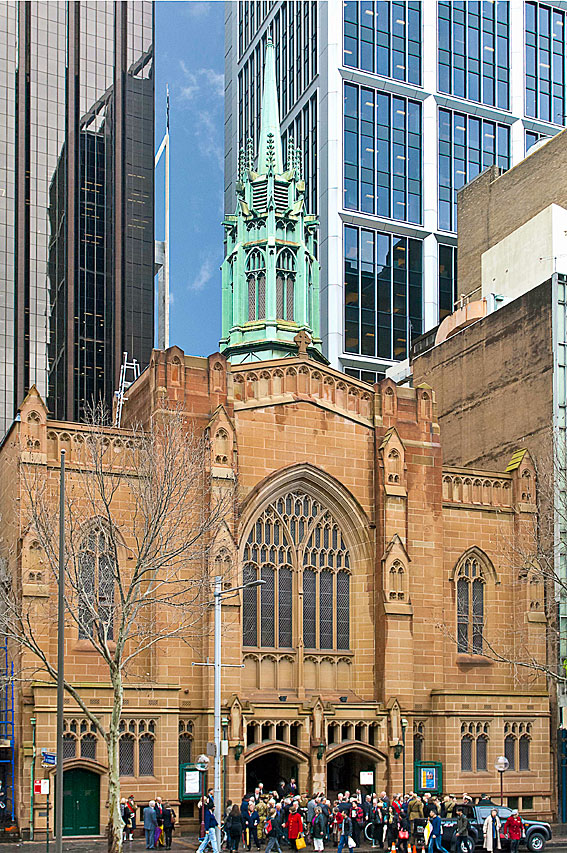
The present St Stephen's Church, formerly Presbyterian, was opened in 1935 and replaced an earlier building in Phillip Street and an even earlier prefabricated "Iron Church" in Macquarie Street near the present site. The organ was built by Hill, Norman & Beard in 1934, replacing a 1879 two manual Henry Willis & Sons organ from the previous church which was moved by Hill, Norman & Beard in 1934 to Armidale Uniting (Methodist) Church. The Phillip Street church was opened in 1857 in neo-Romantic style; the building was completed in 1866 and the tower and spire were added in 1875. The interior of the church was spacious with a gallery on three sides. There is no record of an organ present before the Willis which was located in the west gallery. The case was in Scottish ecclesiastical style with three towers and flats of display pipes arranged 3 - 12 - 3 - 12 - 3.

The former St Stephen's Presbyterian Church in Phillip Street

The Willis organ in the rear gallery
(Two photos above from St Stephen's church display)
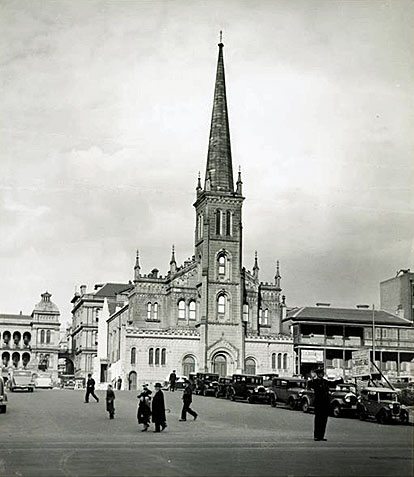
St Stephen's Presbyterian Church, Philip Street
Some buildings have already been demolished to extend Martin Place
up to Sydney Hospital in Macquarie Street
[Photo: Harold Cazneaux, c1930]

The Willis organ now in Armidale Uniting Church (Trevor Bunning 2007)
The specification is as follows:
Henry Willis 1879 (2/15 mechanical) ^
|
GREAT |
|
|
Open Diapason |
8 |
|
Claribel Flute |
8 |
|
Dulciana |
8 |
|
Principal |
4 |
|
Flûte harmonique |
4 |
|
Fifteenth |
2 |
|
Clarionet |
8 |
|
SWELL |
|
|
Diapason |
8 |
|
Lieblich Gedact |
8 |
| Salcional |
8 |
| Vox Angelica |
8 |
|
Gemshorn |
4 |
|
Cornopean |
8 |
|
Tremulant |
|
|
PEDALS |
|
| Open Diapason |
16 |
|
Bourdon |
16 |
COUPLERS
Swell to Great
Great to Pedals
Swell to Pedals
Compass: 56/30
Mechanical action to manuals
Pneumatic action to pedals
General tremulant (by lever pedal)
3 composition pedals to Great & Pedal
3 composition pedals to Swell
Balanced swell pedal
Hill, Norman & Beard 1934
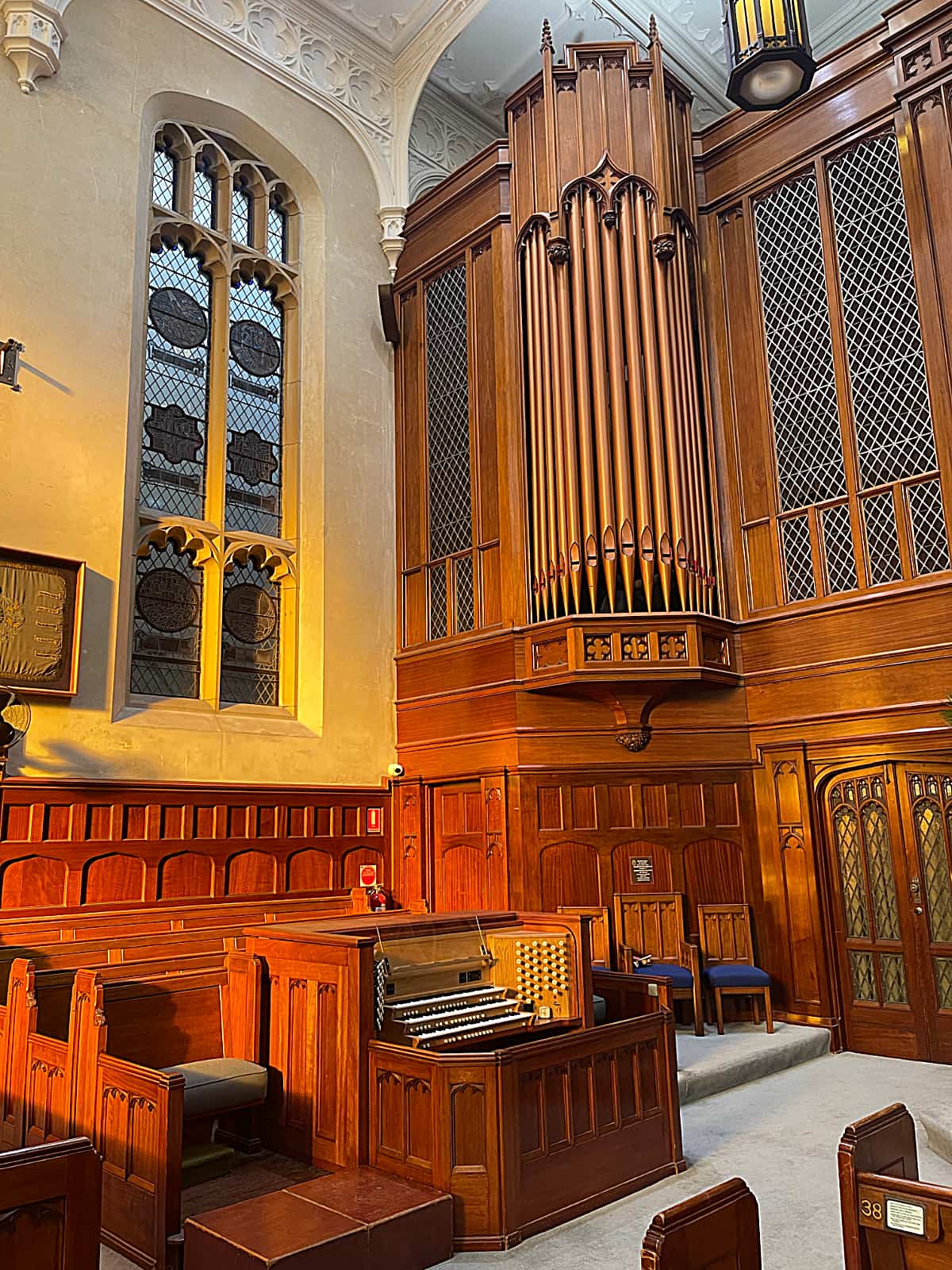
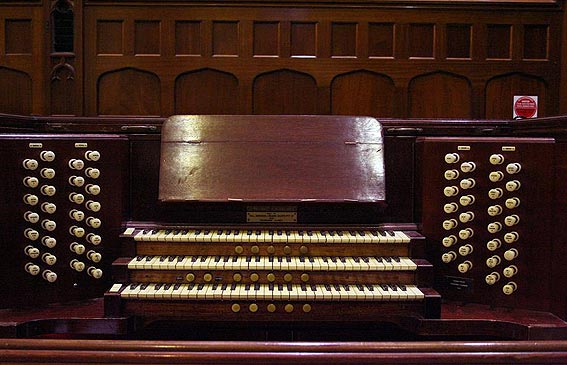
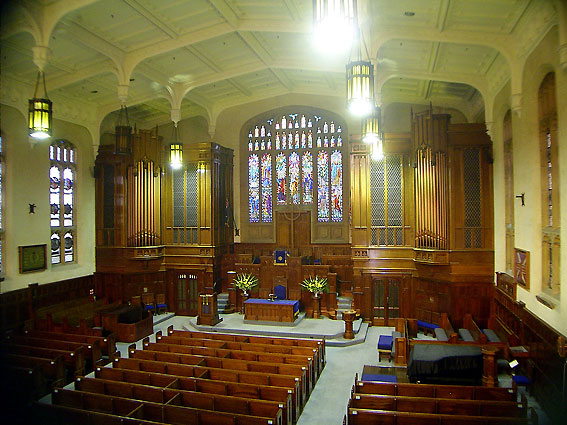
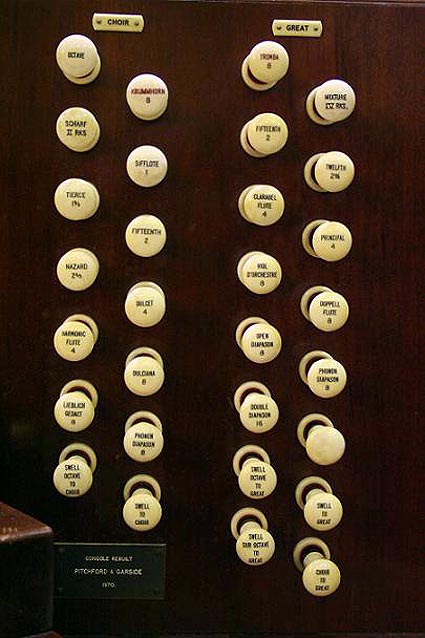
The present church and instrument were opened on 23rd March, 1935. Its specification had been drawn up with the consultation of George Faunce Allman (organist of St James', King St). The stop list included a Tromba and a Phonon Diapason on the Great, these being duplexed to the Choir so they could be used as a Solo division. There was also a stop rarely found on organs in Australia - a Doppel Flute 8'. Of three manuals and 48 stops, this instrument was contained in an imposing Art Deco/neo-Gothic case of Queensland maple displaying towers of pipes with bronze finish. The detached console was equipped with circular stop buttons mounted on angled jambs; these illuminated in the 'on' position and were activated by the merest touch. In less than 20 years after this organ was built, many faults had developed in the electro-pneumatic action, as well as runnings in the windchests. These defects were corrected by HN & B in 1953, and since 1970, Pitchford and Garside have rebuilt the console (removing the illuminating stops) and effected tonal alterations to create a more neo-classical specification. The Choir division had been located on the left hand side of the church with the organ case on the right hand side being totally empty. During the 1970s, the Choir was moved over to the right hand side and left unenclosed, making it more like a Positive division.
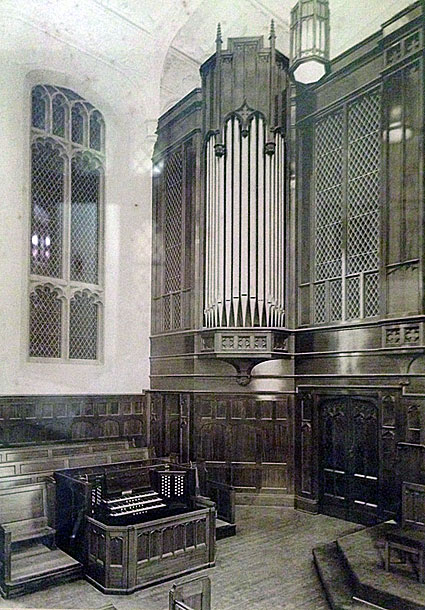
An undated photograph of the St Stephen's organ before it was rebuilt in the 70s.
Note the absence of pew cushions and carpet. The choir stalls are unraked.
The stops are grouped
in threes and featured illuminated discs.
The 1934 specification provided by Stuart Garside was:
| Great Double Open Diapason Phonon Diapason Open Diapason Doppel Flute Viola Principal Octave Diapason Claribel Flute Twelfth Fifteenth Mixture Tromba Swell Contra Viol Open Diapason Concert Flute Viol d'Orchestre Celeste Octave Harmonic Flute Harmonic Piccolo Dulciana Mixture Contra Fagotto Fagotto Trumpet Vox Humana Choir (enclosed) Double Dulciana Phonon Diapason Open Diapason Lieblich Gedact Dulciana Vox Angelica Harmonic Flute Dulcet Dulcet Twelfth Dulcet Fifteenth Dulcet Tierce Clarinet Vox Humana Tromba Pedal Harmonic Bass Major Bass Open Diapason Contra Viol Bourdon Dulciana Octave Cello Contra Fagotto Couplers Great to Pedal Swell to Pedal Choir to Pedal Swell to Great Choir to Great Swell to Choir Swell Octave Swell Sub Octave Swell to Great Octave Swell to Great Sub Octave Swell to Choir Octave Swell Sub Octave to Choir Choir Octave Choir Sub Octave Choir to Great Octave Choir to Great Sub Octave |
16 8 8 8 8 4 4 4 2-2/3 2 III 8 16 8 8 8 8 4 4 2 III 16 8 8 8 16 8 8 8 8 8 4 4 2-2/3 2 1-3/5 8 8 8 32 16 16 16 16 16 8 8 16 |
D A D D H [pipes were marked 'Tuba'] B C C I E A E E E E E I H F + separate Quinte 10-2/3 rank for bottom 12 pipes F D B G E D E? C |
During the 1970's, a number of changes were made to the organ, bringing it into line with the neo-Baroque style prevalent during that time. Many ranks of pipes were moved from one division to another and/or transposed with new pipes supplied to fill the gaps or pipes from other ranks used. It is now difficult to know exactly what has ended up where as several experiments took place and these were not completely documented. All dates of alterations given in 'years' are approximate and as accurate as possible, based on archival correspondance from that period. Some letters talk about experimental work completed (but no date given other than the date on the letter) or proposals for more experiments with moving and transposing of ranks etc. It is recorded that the Phonon Diapason was sold (from TC upwards as the bottom octave was kept) although it does not say to whom. There are no records to say what happened to the Choir Clarinet or the Swell Harmonic Piccolo, Vox Humana and two Celeste ranks. Later information has come to hand in 2021 which indicates the ranks were sold and incorporated into a Wurlitzer Theatre Organ which was then sold and moved to China. The Vox Humana was said to be on 6' wind pressure and of large scale.
Some of these changes included:
• the Choir organ, which had been enclosed in the left hand side case was moved to the right hand side unenclosed in the late 1960s;
• a new Scharf Mixture was added to the Choir organ;
• a new 4' Principal rank was added to the the Great organ. The old 4' Principal rank became the new 2' Fifteenth, with the old 2' rank becoming the new Tweflth;
• the Choir Diapason was moved to the Great in place of the Phonon Diapason and is playable on the Choir and the Great;
• the Swell 8' Trumpet was moved to the Great, with the Great Tromba moving to the Swell at 4' pitch. (In the early 2000s, the 4' Trumpet was returned to its original 8' pitch but was only from tenor C);
• a 16' Posaune and a 4' Schalmei were added to the Pedal department;
• the Great Mixture was moved to the Swell, with pipes from the old Swell Mixture being used to create the new Swell Larigot, Twelfth, Fifteenth and possibly the Choir Nazard; several ranks from both Mixtures were used on the Swell and Choir in experiments and it is unclear what has ended up where; at least one new rank must have been added as there were only three ranks available from the Swell Mixture for the four new stops provided.
• the Celeste and Vox Humana were removed from the Swell division;
• the Choir Clarinet was removed (this was intended to have been replaced with the Krummhorn, which was 'prepared for' but not installed);
• the 32’ Harmonic Bass was disconnected from the Pedal division;
• a Pedal Mixture was added;
• the Vox Angelica was removed from the Choir.

Photo: MQ (Jan 2010)
1970s - c. 2005 Specification
Hill, Norman & Beard 1934 (3/45 electo-pneumatic with several prepared for stops) *
| Great Double Diapason Phonon Diapason Open Diapason Doppell Flute (sic) Viol d'Orchestre Principal Clarabel Flute Twelfth Fifteenth [Mixture 19.22.26.29.] Tromba Swell Contra Viol Open Diapason Concert Flute Viol d'Orchestre Octave Harmonic Flute Twelfth Fifteenth Larigot Mixture 15.19.22. Contra Fagotto Fagotto Trumpet Choir (unenclosed) Phonon Diapason Lieblich Gedact Dulciana Harmonic Flute Dulcet Nazard Fifteenth Tierce Scharf 26.29. [Sifflote] [Krummhorn] Pedal Major Bass Open Diapason Bourdon Dulciana Contra Viol Octave Octave Diapason Principal Mixture 19.22. Posaune Contra Fagotto Schalmei |
16 8 8 8 8 4 4 2-2/3 2 [IV] 8 16 8 8 8 4 4 2-2/3 2 1-1/3 III 16 8 4 8 8 8 4 4 2-2/3 2 1-3/5 II [1] [8] 16 16 16 16 16 8 4 2 II 16 16 4 |
D A D B TC C C TC A E E TC E F D G E B F D D C |
(ex Choir Open Diapason 1974 Pitchford & Garside - former Phonon pipes in bottom octave) (new Pitchford & Garside 1974) (ex Great Fifteenth 1974 Pitchford & Garside) (ex Great Principal 1974 Pitchford & Garside) (prepared for) (ex Swell Trumpet 1974 Pitchford & Garside) (ex Swell HNB Mixture? - Pitchford & Garside 1973) (ex Swell HNB Mixture? - Pitchford & Garside 1973) (ex Swell HNB Mixture? - Pitchford & Garside 1973) (former Great Mixture - Pitchford & Garside 1977) (ex Great Tromba transposed to a 4' - 1974 Pitchford & Garside) [moved over to the righthand side organ case which was previously empty with a fake façade] (ex Choir Open Diapason 1974 Pitchford & Garside - former Phonon pipes in bottom octave) (Pitchford & Garside 1973 - rank from original Swell Mixture?) (Pitchford & Garside 1973 - new pipework or ex Great HNB Twelth?) (added - Pitchford & Garside 1976 - new pipework from Fincham & Sons) (prepared for) (prepared for) (borrowed from the Great Open Diapason 8' Pitchford & Garside c. 1980) (borrowed from the Great Open Diapason 8' Pitchford & Garside c. 1980) (added Pitchford & Garside c. 1980 on former Great Tromba chest) (added Pitchford & Garside 1976 - pipes from Carl Giesecke und Sohn, Germany) (added Pitchford & Garside 1981 on former Great Tromba chest - pipes from Carl Giesecke und Sohn, Germany) |
Swell to Great
Swell Octave to Great
Swell Sub Octave to Great
Choir to Great
Swell to Choir
Swell Octave to Choir
Swell Octave
Swell Sub Octave
Choir Octave
Swell to Pedal
Great to Pedal
Choir to Pedal
5 pistons to Great
5 pistons to Swell
5 pistons to Choir
5 pistons to Pedal
Great to Pedal reversible toe piston
Swell to Pedal reversible toe piston
Swell to Great reversible toe piston
Great to Pedal reversible thumb piston
Swell to Great reversible thumb piston
Swell tremulant (rocker tab on left Swell key cheek)
Choir tremulant (rocker tab on left Choir key cheek)
Specification from 2005-2020
Hill, Norman & Beard 1934 (3/51 electro-pneumatic)
| Great Double Diapason Phonon Diapason Open Diapason Doppell Flute (sic) Viol d'Orchestre Principal Clarabel Flute Twelfth Fifteenth Mixture 22.26.29 Double Trumpet Trumpet Clarion Swell Contra Viol Open Diapason Concert Flute Viol d'Orchestre Voix Celeste Octave Harmonic Flute Twelfth Fifteenth Mixture 15.19.22. Contra Fagotto Trumpet Fagotto Choir (unenclosed) Phonon Diapason Lieblich Gedact Dulciana Gemshorn Harmonic Flute Dulcet Nazard Fifteenth Tierce Clarinet Double Trumpet Trumpet Clarion Pedal Resultant Bass Major Bass Open Diapason Bourdon Dulciana Contra Viol Octave Octave Diapason Mixture 19.22. Trombone Posaune Trumpet |
16 8 8 8 8 4 4 2-2/3 2 III 16 8 4 16 8 8 8 8 4 4 2-2/3 2 III 16 8 8 8 8 8 4 4 4 2-2/3 2 1-3/5 8 16 8 4 32 16 16 16 16 16 8 4 II 16 16 8 | A C A B B B F TC E E A D D TC D B B B G + H G A H D F G A B B |
(ex Choir Open Diapason 1974 Pitchford & Garside - former Phonon pipes in bottom octave) (new Pitchford & Garside 1974) (ex Great Fifteenth 1974 Pitchford & Garside) (ex Great Principal 1974 Pitchford & Garside) (reconfigured from the Choir Scharf II and moved over to the Great in Jan 2013 with one new rank added Darrell Pitchford) (originally Great Tromba 8' which became Swell Trumpet 4' in 1974 by Pitchford & Garside, then became Swell Trumpet 8' with bottom octave missing c. 2005, removed from Swell 2013. Replaced 2014 by former Great Trumpet from St Andrew's Cathedral's Whiteley organ - extended pipework by Whiteley 1920s and HN & B 1948) (added Darrell Pitchford 2010 in place of Larigot 1-1/3') (ex Swell HNB Mixture? - Pitchford & Garside 1973) (ex Swell HNB Mixture? - Pitchford & Garside 1973) (former Great Mixture - Pitchford & Garside 1977) (became Great Tromba 1974 Pitchford & Garside. Returned to Swell by Darrell Pitchford Jan 2013) [in the righthand side organ case] (ex Choir Open Diapason 1974 Pitchford & Garside - former Phonon pipes in bottom octave) (added Darrell Pitchford in Jan 2013 in place of the former Scharf II) (Pitchford & Garside 1973 - rank from original Swell Mixture?) (Pitchford & Garside 1973 - new pipework, ex Great HNB Twelth?) (enclosed in Swell box, added by Darrell Pitchford in Jan 2013 using rank from a 1935 HN&B organ in the UK) (added Darrell Pitchford 2014) (added Darrell Pitchford 2014) (added Darrell Pitchford 2014) (reconnected Darrell Pitchford Dec 2009 in place of Principal 2') (borrowed from the Great Open Diapason 8' Pitchford & Garside c. 1980 and was also extended to Principal 2') (added Pitchford & Garside c. 1980 on former Great Tromba chest) (added Darrell Pitchford 2014) (added Pitchford & Garside 1976 - pipes from Carl Giesecke und Sohn, Germany) (added Darrell Pitchford 2014) |
Couplers
Swell to Great
Choir to Great
Swell to Choir
Swell Octave to Choir
Swell Octave
Swell Sub Octave
Swell to Pedal
Great to Pedal
Choir to Pedal
Pistons
5 pistons to Great (also work the Pedal Pistons)
5 pistons to Swell
5 pistons to Choir
5 pistons to Pedal (also work the Great Pistons)
General Cancel
Great to Pedal reversible toe piston
Swell to Pedal reversible toe piston
Swell to Great reversible toe piston
Great to Pedal reversible thumb piston
Swell to Great reversible thumb piston
Swell tremulant (rocker tab on left Swell key cheek)
Choir tremulant (rocker tab on left Choir key cheek)
Compass: 61/30
Current Specification (2021)
Hill, Norman & Beard 1934 (3/60 electro-pneumatic)
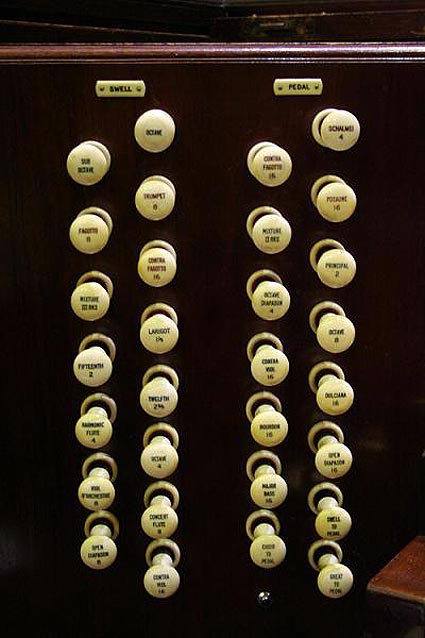
In February 2021, a new console was installed. This was built by Daniel Bittner from Australian Pipe Organs in Melbourne, Victoria, and was required to have the same external appearance as the previous one due to heritage requirements. While the organ was manufactured by Hill, Norman & Beard in their Melbourne factory, it is now believed that the original console may have been built in the UK for a couple of reasons. All the timber in the church is Queensland Maple yet the console was made from Mahogany. There are carvings on both sides of the console which bear no resemblance to any of the carvings found on the pew ends, lecturn, pulpit and organ case. The new console has been built from Queensland Maple and the carvings have been copied from the carvings found on all the pew ends. Provision has been made for all the removed stops to be returned (except for the Choir Vox Humana which would no longer be under expression if returned to the Choir division). A new combination action has been installed which adds multiple memory levels, general pistons and a sequencer to what was previously only available using an internal setter board located behind the music desk.
| Great Double Diapason Phonon Diapason* Open Diapason Doppel Flute Viol d'Orchestre Principal Octave Diapason Clarabel Flute Twelfth Fifteenth Mixture 22.26.29 Double Trumpet Trumpet Clarion Swell Contra Viol Open Diapason Concert Flute Flute Celeste* Viol d'Orchestre Voix Celeste Principal Harmonic Flute Fifteenth Mixture 15.19.22. Contra Fagotto Trumpet Fagotto Clarion Tremulant Choir (unenclosed) Dulciana Phonon Diapason* Open Diapason Lieblich Gedact Dulciana Gemshorn Harmonic Flute Dulcet Nazard Fifteenth Harmonic Piccolo* Tierce* Larigot* Dulciana Mixture 12.15. Fagotto Clarinet Double Trumpet Trumpet Clarion Tremulant Pedal Resultant Bass Major Bass Open Diapason Bourdon Dulciana Contra Viol Octave Dulciana Octave Diapason Mixture 19.22. Trombone Posaune Trumpet |
16 8 8 8 8 4 4 4 2-2/3 2 III 16 8 4 16 8 8 8 8 8 4 4 2 III 16 8 8 4 16 8 8 8 8 4 4 4 2-2/3 2 2 1-3/5 1-1/3 II 8 8 16 8 4 32 16 16 16 16 16 8 8 4 II 16 16 8 |
A C A A B B B F E E E D A D D TC D E B B B G + H G A H D F G D A B B |
(currently ex Choir Open Diapason 1974 Pitchford & Garside - former Phonon pipes in bottom octave) Prepared for (new Pitchford & Garside 1974) (reconnected Darrell Pitchford 2021) (ex Great Fifteenth 1974 Pitchford & Garside) (ex Great Principal 1974 Pitchford & Garside) (reconfigured from the Choir Scharf II and moved over to the Great in Jan 2013 with one new rank added Darrell Pitchford) (originally Great Tromba 8' which became Swell Trumpet 4' in 1974 by Pitchford & Garside, then became Swell Trumpet 8' with bottom octave missing c. 2005, removed from Swell 2013. Replaced 2014 by former Great Trumpet from St Andrew's Cathedral's Whiteley organ - extended pipework by Whiteley 1920s and HN & B 1948) Prepared for (to replace the second celeste which was on the enclosed Choir) (added Darrell Pitchford 2010 in place of Larigot 1-1/3') (previously called Octave) (ex Swell HNB Mixture? - Pitchford & Garside 1973) (ex Swell HNB Mixture? - Pitchford & Garside 1973) (former Great Mixture - Pitchford & Garside 1977) (became Great Tromba 1974 Pitchford & Garside. Returned to Swell by Darrell Pitchford Jan 2013) (extended from the Fagotto, Darrell Pitchford 2021) Prepared for [in the righthand side organ case] (reconnected Darrell Pitchford 2021) Prepared for (currently playing the Open Diapason) Connected to the Phonon Diapason stop (added Darrell Pitchford in Jan 2013 in place of the former Scharf II) (Pitchford & Garside 1973 - rank from original Swell Mixture?) (Pitchford & Garside 1973 - new pipework, ex Great HNB Twelth?) Prepared for (previously extended from the Dulciana - new rank prepared for) (formally added to the Swell and removed for replacement of Celeste 2010, added Darrell Pitchford 2021) (extended from Dulciana rank Darrell Pitchford 2021) (enclosed and borrowed from the Swell, Darrell Pitchford 2021) (enclosed in Swell box, added by Darrell Pitchford in Jan 2013 using rank from a 1935 HN&B organ in the UK) (added Darrell Pitchford 2014) (added Darrell Pitchford 2014) (added Darrell Pitchford 2014) Prepared for (reconnected Darrell Pitchford Dec 2009 in place of Principal 2') (reconnected Darrell Pitchford 2021) (borrowed from the Great Open Diapason 8' Pitchford & Garside c. 1980 and was also extended to Principal 2') (added Pitchford & Garside c. 1980 on former Great Tromba chest) (added Darrell Pitchford 2014) (added Pitchford & Garside 1976 - pipes from Carl Giesecke und Sohn, Germany) (added Darrell Pitchford 2014) |
Couplers
Swell to Great
Choir to Great
Great to Pedal
Swell to Pedal
Choir to Pedal
Swell Octave
Swell Sub Octave
Swell Unison Off
Gt & Ped Pistons Coupled
Pistons
12 General thumb pistons
8 General toe pistons
8 Divisional pistons to Great
8 Divisional pistons to Swell
8 Divisional pistons to Choir
8 Divisional pistons to Pedal
General Cancel piston
Setter piston
Scope piston
Great to Pedal reversible thumb piston
Swell to Pedal reversible thumb piston
Choir to Pedal reversible thumb piston
Swell to Great reversible thumb piston
Swell to Choir reversible thumb piston
Choir to Great reversible thumb piston
Great to Pedal reversible toe paddle
Swell to Pedal reversible toe paddle
Choir to Pedal reversible toe paddle
Swell to Great reversible toe paddle
Choir to Great reversible toe paddle
Tutti thumb piston
Tutti reversible toe paddle
32' Resultant Bass reversible toe piston
16' Trombone reversible toe piston
5 Next thumb pistons
1 Next toe piston
1 Back thumb piston
1 back toe piston
999 levels of General memory
10 levels of Divisional memory
Compass: 61/30
|
||
 |
||
  |
||
 |
||
 |
 |
|
|
Photos of old console (Mark Quarmby, 2009) 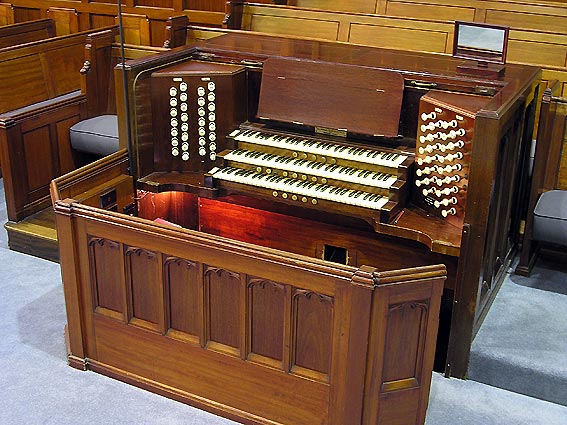 Photo: Simon Colvin |
||
 Photo: Simon Colvin |
||
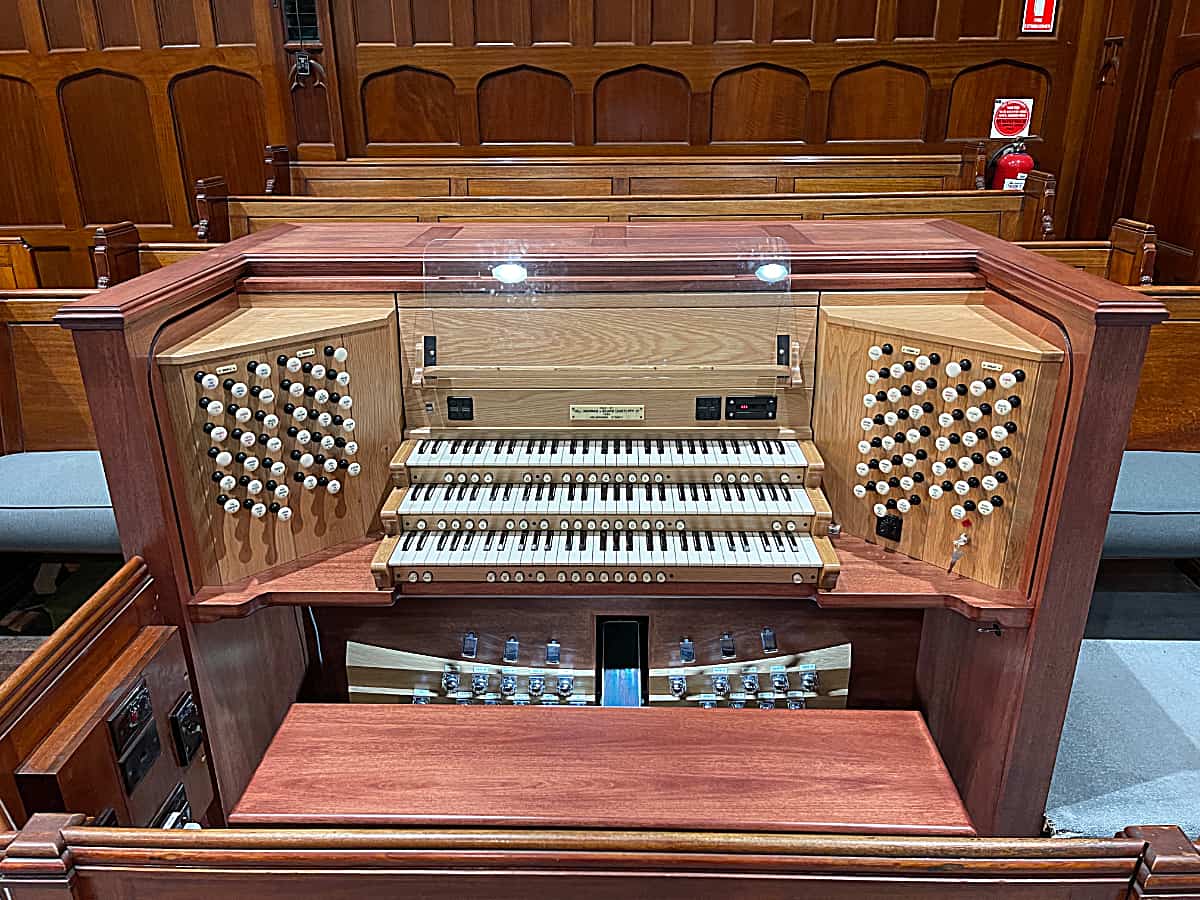
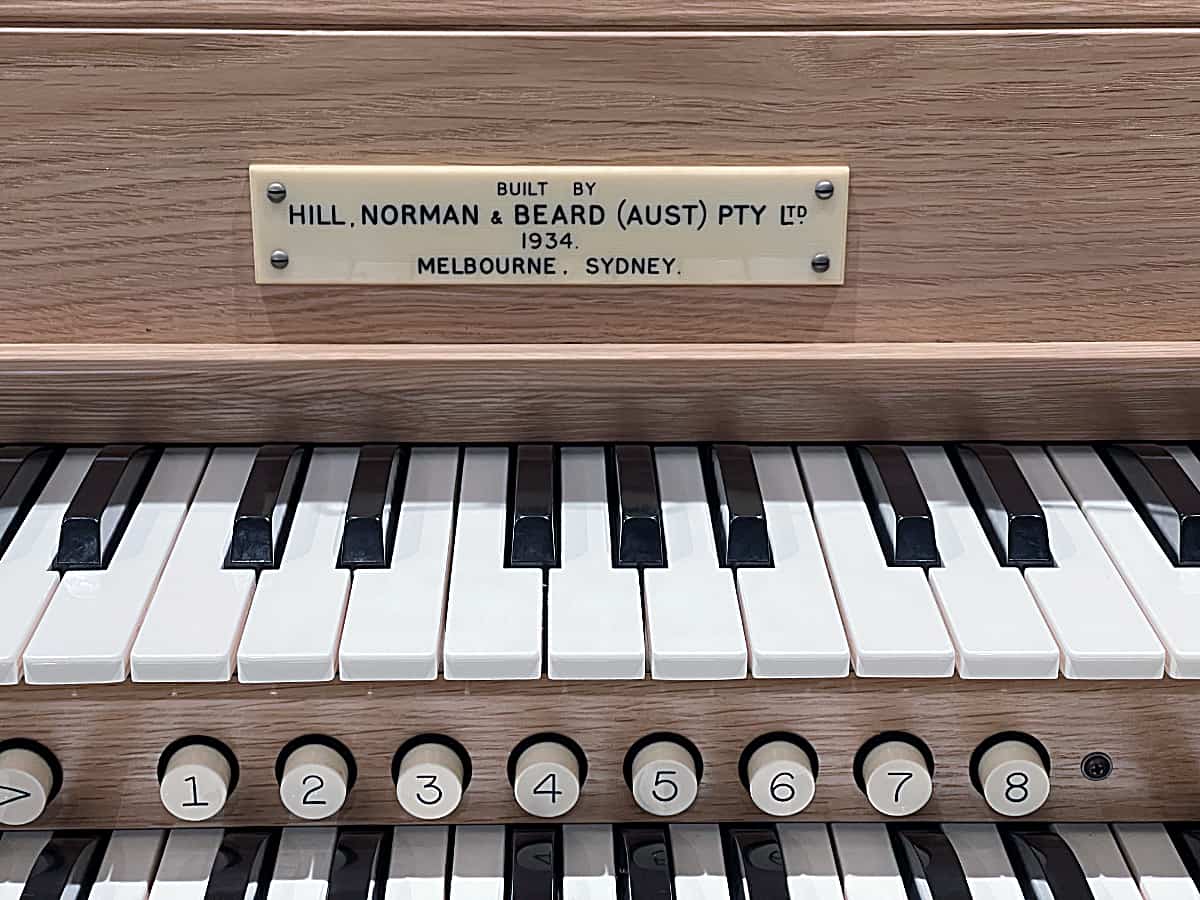
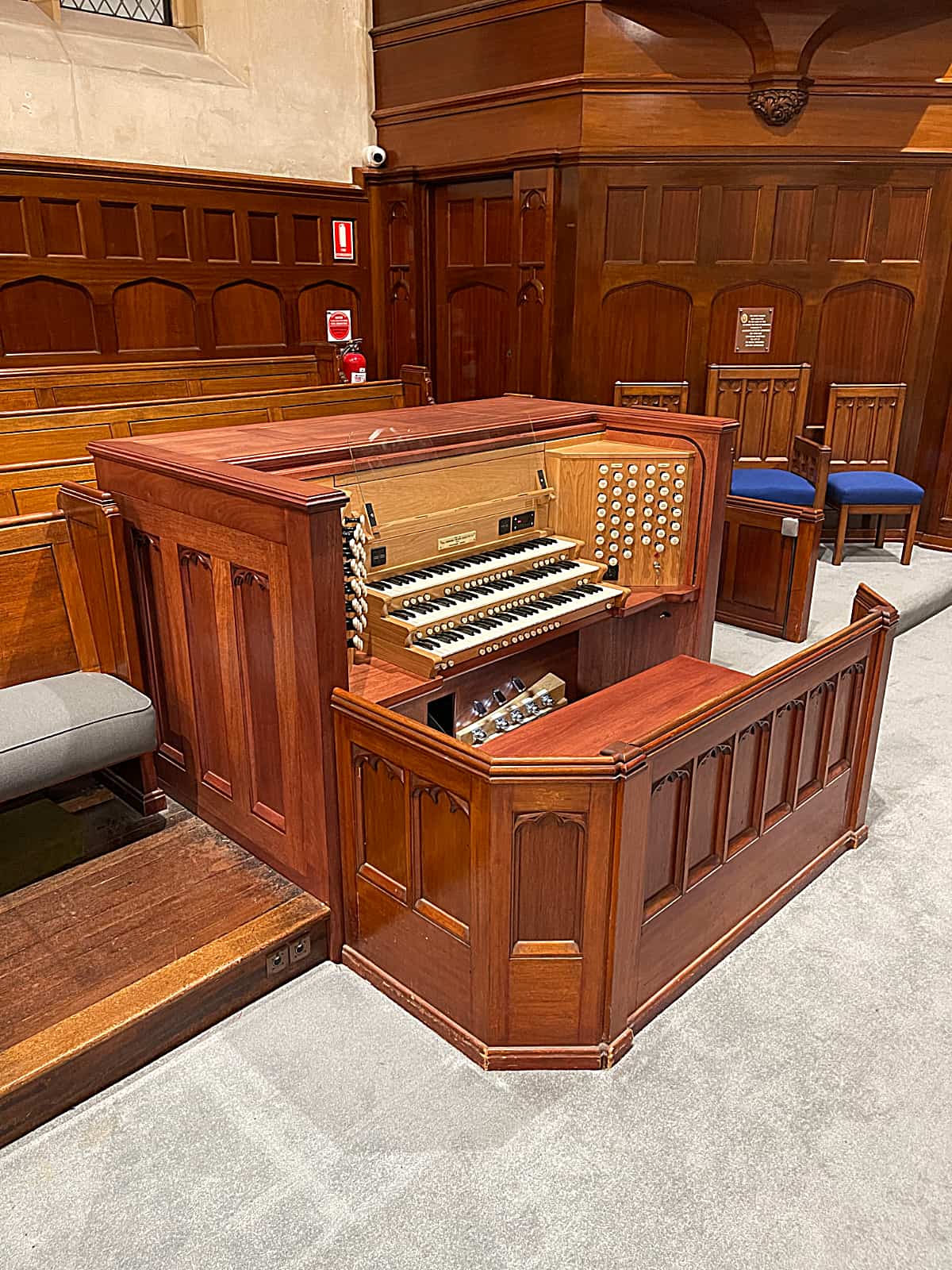
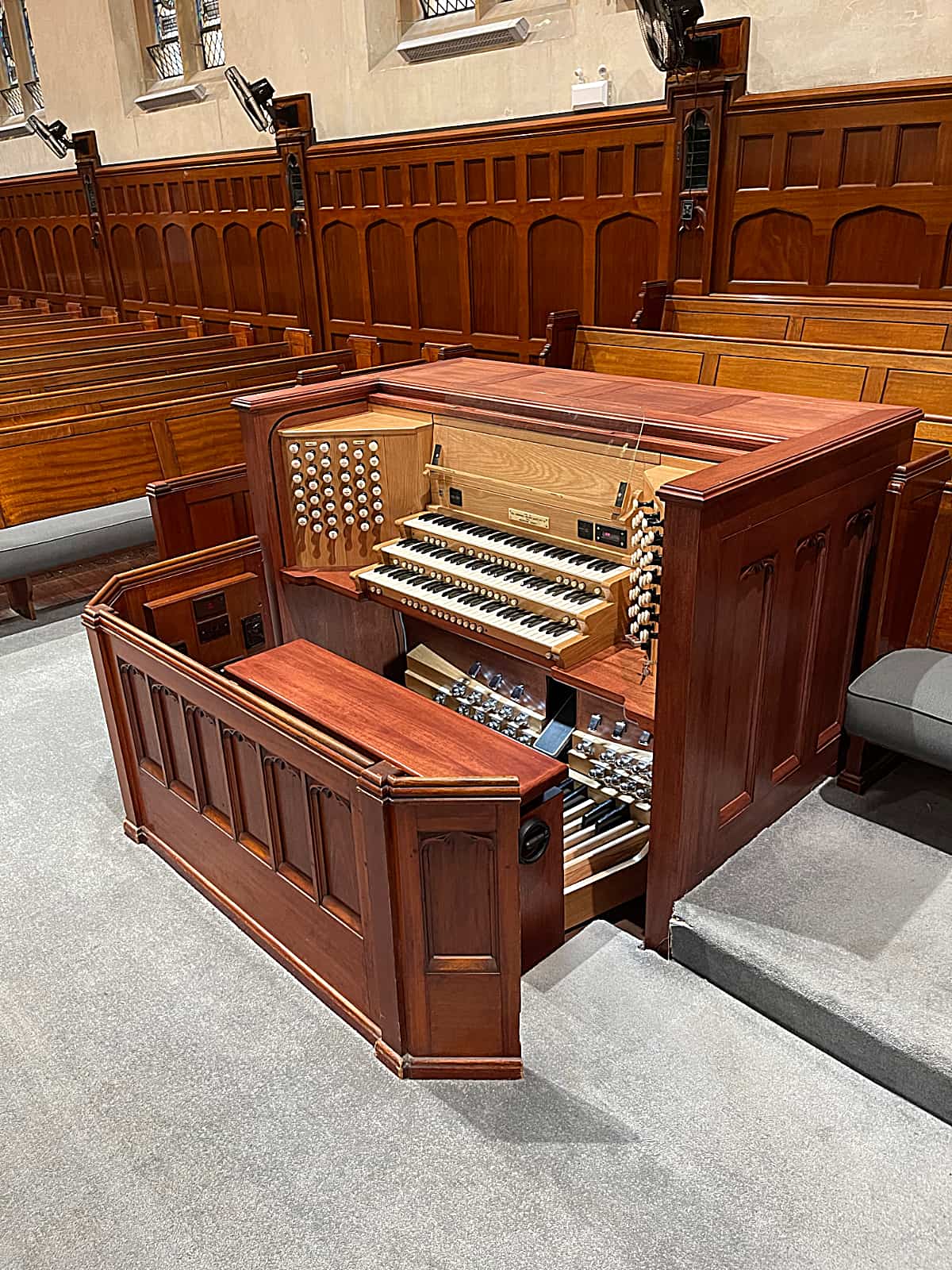
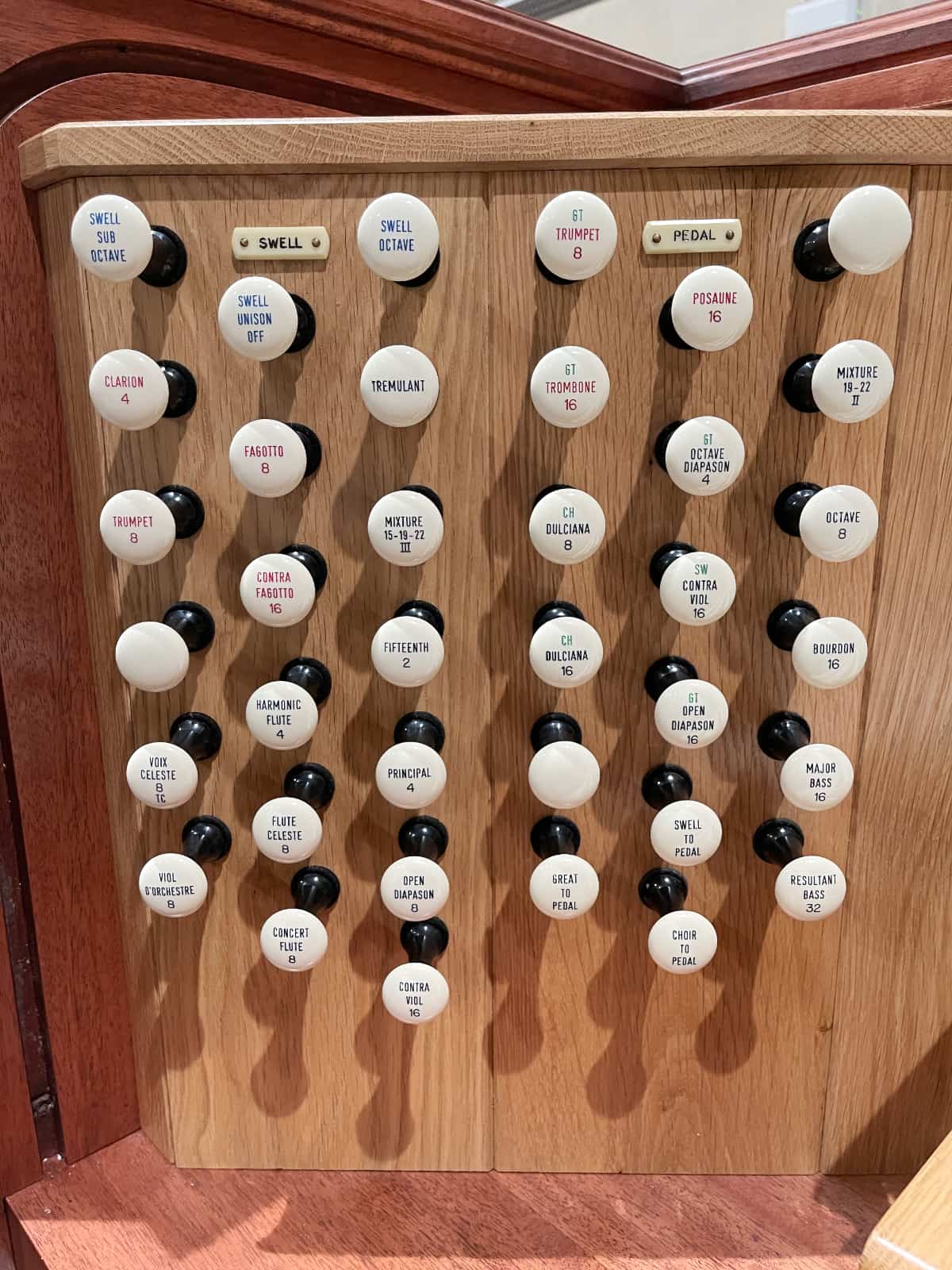
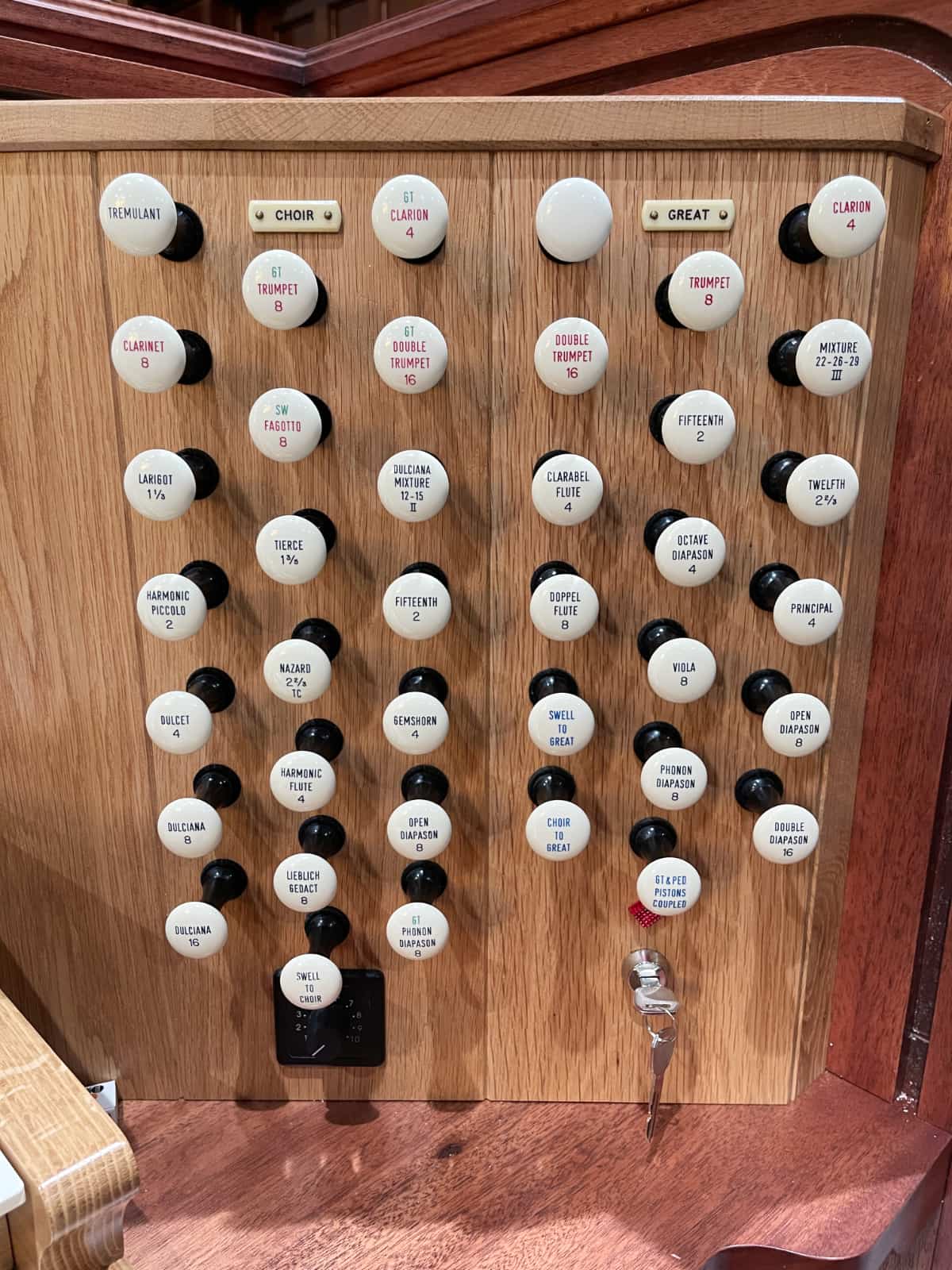
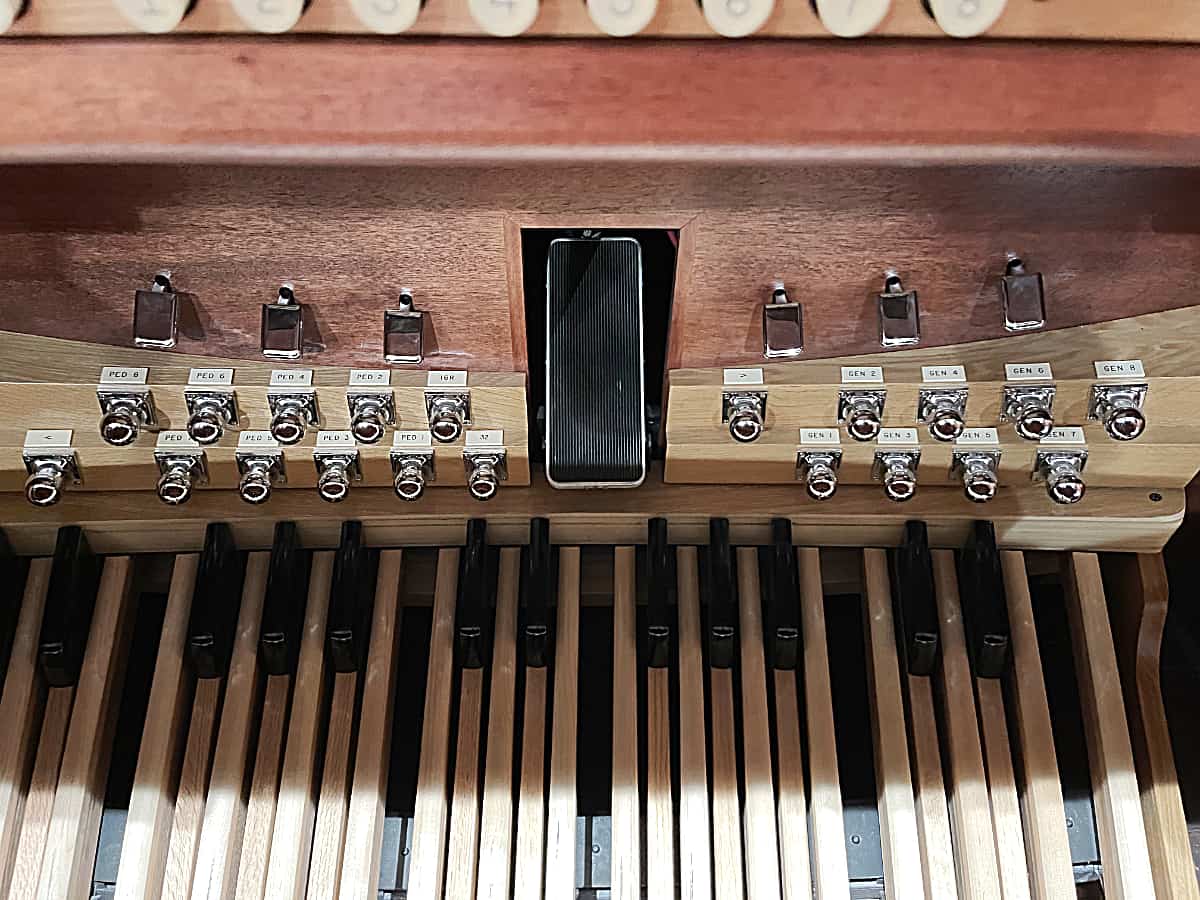
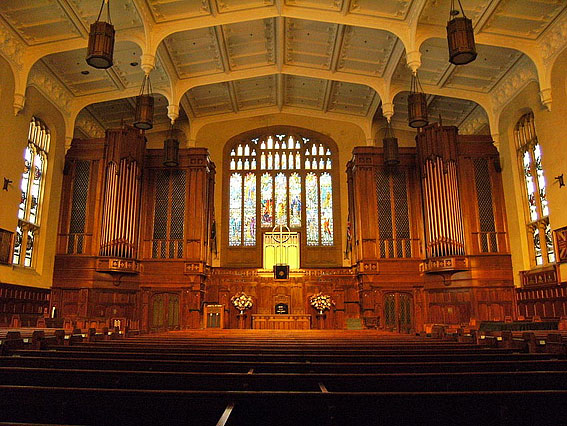
Photo: MQ (Jan 2010)
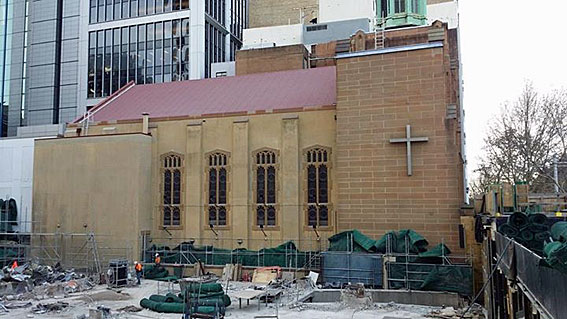
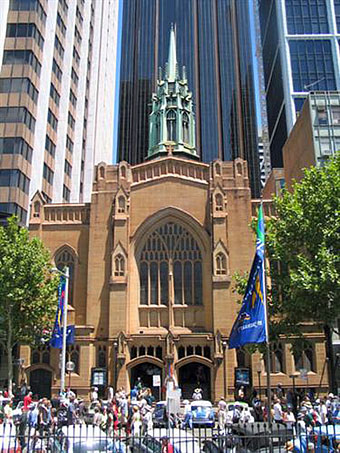
View of church from Martin Place after the Westpac Bank was demolished (July 2017)
The main organ chamber can be seen on the left hand end of the church.
[Photo: Rev Ken Day]
^ Information from Historic Organs of NSW, G Rushworth 1988
* Changes to the organ noted from the church archives and the Sydney Organ Journal March 1970, May 1976, Dec 1976, Feb 1978 and Dec/Jan 1981-2 with obvious corrections noted by St Stephen's organists Daniel Dries, Peter Guy and Mark Quarmby.
Photos by Daniel Mitterdorfer 2006